Friday, 11 May 2018
Cannes 2018 - Cold War by Pawel Pawlikowski
Polish director Pawel Pawlikowski had made a name for himself with a series of gritty, realistic British films (while he was born in Poland, he has lived most of his life in Britain). He returned to his home country to make the stunning Ida (2013) to worldwide acclaim and the film went on to win the Oscar for best Foreign film.
In appearance, Cold War seems similar, a Polish language film shot in black & white. Yet they could not be more different. Ida had a beautiful austerity and restraint to it whereas Cold War lets it all out, even going for a jazzy and boozy vibe as the story moves from Eastern Europe to France.
Movie nut, born in France, living in London, holding the enviable title of the only person ever to have been suspended from school for skipping class to attend the Cannes Film Festival...
Cannes 2018 - Arctic by Joe Penna
Survival films are terribly compelling, whether it's the beautiful, wild landscapes they are set in, the man against nature primal theme, or just the soothing schadenfreude of watching somebody exposed to the elements having a terrible time, while in the comfort of a cinema/your own home.
Some directors down the action route, others use the premise as a metaphor about the might and indifference of nature (Werner Herzog!)... In Arctic, Joe Penna chooses the path of realism. The film smartly opens right after the crash of a light aircraft that caused Overgård (Mads Mikkelesen) to find himself alone in the arctic wild, with no other survivors. We are spared the usual introductory scenes, we do not know the first thing about him, giving his plight for survival a raw simplicity.
Movie nut, born in France, living in London, holding the enviable title of the only person ever to have been suspended from school for skipping class to attend the Cannes Film Festival...
Thursday, 10 May 2018
Cannes 2018 - Gräns by Ali Abbasi
A Scandinavian genre film, with a screenplay written by John Ajvide Lindqvist (author of Let The Right One In) is a salivating prospect, and indeed Gräns shares some similarities with the Swedish horror classic. In it, Tina (Eva Melander), a border inspector with an uncannily developed sense of smell, lives a lonely life due to her unusual appearance, when a stranger enters her life, one she feels a connection with, without quite understanding why at first.
Gräns is immediately captivating thanks to its inspired visuals and pervading sense of oddness. While the interiors are purposefully pictured as drab and depressing, being houses or workplaces, far from the usual stereotypes of Swedish Ikea living, in contrast nature is filmed beautifully, not in an idealised, elegiac way, but in a very earthy and tactile manner, with crawling insects and soil in close-up, a place not so much accepting as indifferent, and where Tina finds some solace.
Movie nut, born in France, living in London, holding the enviable title of the only person ever to have been suspended from school for skipping class to attend the Cannes Film Festival...
Wednesday, 9 May 2018
Cannes 2018 - Everybody Knows by Asghar Farhadi
In Everbody Knows, Laura (Penélope Cruz) returns to a Spanish village for a big family wedding, having made her life in Argentina. The celebration takes a turn for the worst however, as her teenage daughter Irene (Carla Campra) is kidnapped the night of the wedding. Unable to contact the police due to threats from the kidnappers, the family members tear each other apart as they attempt to solve the mystery and rescue her.
When a director travels to a completely different country to its own, and films in a different language, there is an inherent danger that their style will not translate well, that they might have a superficial outlook over a culture they are unfamiliar with. Of course, it can also works beautifully (see Paul Verhoeven recently, with Elle).
Movie nut, born in France, living in London, holding the enviable title of the only person ever to have been suspended from school for skipping class to attend the Cannes Film Festival...
Saturday, 7 April 2018
Western by Valeska Grisebach
Armed with an Arri Alexa and a cast of non-actors, Valeska Grisebach crafts Western as exactly the kind of film you’d expect to see in the Un Certain Regard sidebar of Cannes. Naturalistic, unaffected acting? Check. Handheld camera? Check.
Socially-relevant/political plot and thematic content? Check. The socially-relevant plot here follows a group of German men travelling to a village in Bulgaria, tasked with building a new hydro-plant. The men make no attempt to integrate into their new residence. One actually raises the German flag atop their construction site, heedless to how a Bulgarian, especially one with a sense of European history, might read such an act. The men may still be in the EU, but they clearly don’t think of this backwater as worthy of courtesy.
Movie nut, born in France, living in London, holding the enviable title of the only person ever to have been suspended from school for skipping class to attend the Cannes Film Festival...
Saturday, 24 March 2018
BFI Flare 2018: Documentaries
Love, Scott
Dir: Laura Marie Wayne
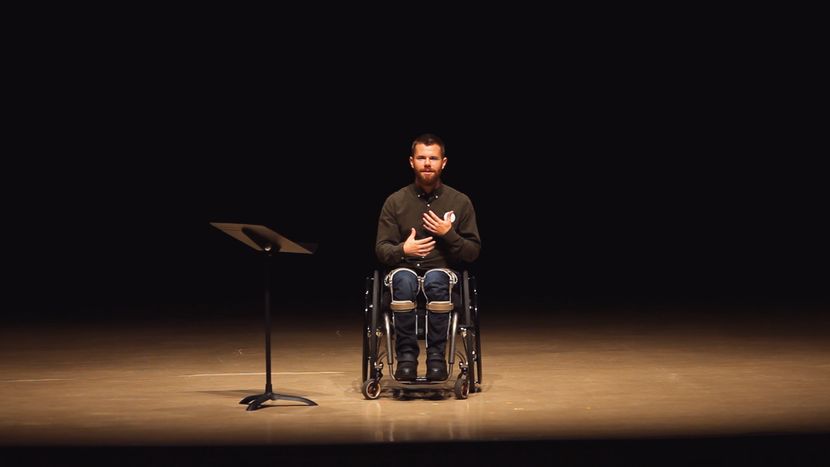
After a night out in a bar in Nova Scotia, musician Scott Jones was attacked. He was stabbed in a homophobic attack which left him paralysed from the waist down. The courts didn't recognise the attack as a hate crime, sentencing Scott's attacker to 10 years for attempted murder. This documentary, by a college friend of Scott's, picks up with him about a year after the attack, as he rebuilds and tries to find something useful to do in what he call his new normal.
Laura Marie Wayne's film is a tender portrait of a friend. She has access to some archive footage from Scott's childhood, which she pairs with more shot on film material to give an impressionistic feel of the past, like fragments of grainy memories that flash through the film periodically. The first present tense material takes place five days after Scott's attack, when she visits him in the hospital, and while it comes midway through the film, after we have spent plenty of time with Scott as he is now, it feels like the bridge between the past and present tenses. What's striking about this footage is how little of it is of Scott. There are snatches of hospital corridors, the floor, the walls. It's almost as if Wayne can't bear, at least in the first moments, to see her friend in pain, to see him helpless.
Of course, Scott isn't helpless. Not only is he facing up to the challenges of the aftermath of his attack, he's trying to use his voice in helpful, hopeful, ways. He's founded the Don't Be Afraid campaign, named for what he said in hospital when asked what he'd want people to know in the wake of what happened to him. Through that group he leads a choir and does public speaking. We see all of this in the film, from small events like a choir rehearsal to much bigger moments like a speaking event that, in one of the film's most moving moments, becomes the first time Scott stands in public since the attack. Scott seems to have perspective on what happened, but we also see, that that's a process that continues for him, especially in relation to the perpetrator. In another of the film's wrenching moments, Scott reads a letter he's written, asking his attacker - Shane - if they can meet.
This is a moving and inspiring story, told articulately by Scott, his sister Sherise and by Wayne's camera. It's also a beautifully shot film, full of evocative images, whether it's the grainy moments of the past or the sequence of Scott being carried on a friend's back, down to a quiet piece of countryside he thought he'd not be able to access again after his paralysis. It's well worth seeing on a big screen.
The 34th
Dir: Linda Cullen, Vanessa Gildea
In some ways, it surprises me that the batlle for equal marriage rights for gay and lesbian couples is one that is so recent - or, in many countries, current. It seems like such an obvious imbalance, and so clear that there would be no demonstrable effect on anyone other than the gay and lesbian couples wanting to be married, that it feels like an argument that should have been had and won generations ago. But that's a view from outside the LGBT communities, from a liberal family.
The 34th covers the battle for full marriage equality in the Republic of Ireland, via the 34th amendment to the country's constitution, beginning with the court case brought by Katharine Zappone and Ann Louise Gilligan, who married in Canada in 2003, to have their marriage recognised by the Government and the tax office and ending with the 2015 referendum on the constitutional amendment.
The film itself is very straightforward: a series of talking heads interviews with the key people in the marriage equality movement, mixed with well chosen archive footage, tracking the 12 year journey to victory in well told and often deeply personal detail. It's an important document of a movement that achieved seismic social change in a country where religion remains so powerful that it seemed very possible that that change would never be allowed to take place.
The 34th is interesting, it's emotional and it has a story worth telling. The last twenty minutes in particular, from a speech by two adult children of gay couples at the constitutional convention to the celebrations after the referendum was won, put a lump in my throat. What it's not is cinema. Produced by an Irish television company, the film never really transcends its small screen feel. The visuals are funtional; they tell the story, but aren't especially striking in and of themselves. That's not entirely a bad thing, this film will likely land on the BBC's Storyville series, or some similar strand, and it will be well worth watching there, but I'm not sure you need to rush to a cinema for this one.
Friday, 23 March 2018
BFI Flare 2018: My Days of Mercy
Dir: Tali Shalom-Ezer
At every American prison that has them, executions tend to be greeted with two opposing protest groups. On one side are the victim’s advocates groups, who protest in support of the death penalty, on the other the anti death penalty groups, advocating for the prisoners and protesting the use of execution as a sentence. My Days Of Mercy finds two young women from opposite sides - Pro death penalty Mercy (Kate Mara) and anti death penalty Lucy (Ellen Page) - first finding connection and then perhaps love across this political divide. It’s a complicated relationship, all the more so because Lucy’s father Simon (Elias Koteas) is on death row for murdering his wife.
Ellen Page and Kate Mara have been offscreen friends for some time, and have apparently been looking for a project to act in together for several years. Some might find it disappointing that their first project (which they also co-produced) isn’t a Tiny Detectives movie, but My Days Of Mercy gives each of them one of their most interesting roles, well drawn characters and a relationship to invest in.
Lucy and her family - older sister Martha, played by the always excellent Amy Seimetz and a younger brother Benjamin (Charlie Shotwell) - are the film’s main focus. As her father’s case comes down to the wire and an execution date looms, their lawyer, Weldon (Brian Geraghty) is hopeful that there may still be avenues to explore for getting Simon, who Martha believes is innocent, more so than Lucy does, off death row and maybe completely cleared. These scenes are my main sticking point with My Days of Mercy. At a script level I didn’t buy the derisive way that Lucy treats Weldon, nor the way that he offers so few caveats when talking about the potential effects of ‘new evidence’ on Simon’s case. I’m not sure, from Geraghty’s performance, how competent we’re supposed to read Weldon as being.
Outside these scenes though, the family dynamic is believeable. Even when there is tension between them, you get the sense that Lucy and Martha are close, that they love each other and their younger brother. There is an ease about the way Page, Seimetz and Shotwell work together that gives scenes in their RV, as they travel to and from execution protests, the familiar feel of a typical family road trip which, to some degree, they are for these characters.
Ellen Page is an actress I’ve always liked, but I’ve not cared for some of her recent films. My Days Of Mercy, for the first time in a while, uses her really well. Page’s Lucy is tough, smart, witty and loving, often in the same moment. Page often shows us how Lucy is hiding hurt, it’s not just in the moment when she first tells Mercy about her father, we see it throughout, notably in the moment she’s saying goodbye to Mercy after they have spent the night together, and doesn’t want to show her unwell little brother either that she’s hurting, or what her relationship with Mercy really is. Page plays Lucy’s outward emotions well, but it’s the way that she always lets us see under the surface that impresses.
Kate Mara has the smaller part, and Mercy is seen entirely in how she relates to Lucy. It’s here that Page and Mara’s off screen friendship pays great dividends. The two play off each other beautifully, their obvious affection for each other seeming to lift both of their performances. The relationship between Lucy and Mercy grows credibly and patiently. It’s easy to write quirky characters. What’s harder to pull off, what screenwriter Joe Barton does well here, is to give us characters who just feel like real people in a situation that, for most of us, is unfamiliar. Page and Mara have a playful chemistry throughout, one that grows from their first drink together, to a sequence when Mercy, having upset Lucy, offers to drive her home from a protest (several states away), and into their intimate scenes. Their connection comes across powerfully in some of the smallest moments; the silent goodbye when Benjamin is watching, Mercy taking out the hair tie to tie Lucy's hair back when hers breaks. The sex scenes are frank, but that sense of connection that carries through the entire love story between Lucy and Mercy makes them feel a little less exploitative than they otherwise might.
Director Tali Shalom-Ezer largely keeps things simple, but she finds some nice stylistic touches, like the simplicity of introducing each execution and protest with a static shot of the last meal and captions detailing the prisoner and his crime. Of course this becomes more impactful as the number of executions grows, and when we finally have to go inside the prison in the film’s last act (leading to scenes in which Page and Seimetz, in particular, are devastatingly good). The screenplay combines the political questions with the relationship story effectively, and while I think it’s clear which side the filmmakers eventually come down on, the politics are never hectoring. The way they are represented, in fact, is as more of an outgrowth of experience than of principal, and viewed like that it’s easy to see either side of the issue. This isn’t an issue movie though, and all of the politics feeds into character and most importantly into the relationship that is the heart of the film.
I would expect My Days Of Mercy to see a UK release some time around the end of the year, and it’s worth seeking out when it does.
Subscribe to:
Posts (Atom)